To verify a rental listing, cross-check its address, photos, rent, viewing process, and requests for documents or money before proceeding. Even when an exact address and building are real, they do not prove that the advertiser is authorised to let the home, that the property is available, or that the listing is legitimate.
Quick Answer: Confirm that the building and listing details are consistent, reverse-search every important photo, insist on a normal viewing, and protect application documents. Do not pay before signing the lease. A real address never proves the advertiser's authority, the property's availability, or the legitimacy of the rental listing.
Which official warning signs can reveal a fake rental listing?
The official French guidance Online property rental scams, reviewed on 16 October 2024 by Service Public, describes a fake listing as an offer for a property that does not exist, is unavailable, or is advertised by someone who is not its owner. It identifies five practical warning signs:
- rent that is unusually low for the location, floor area, or standard;
- photographs that are visible in another listing;
- an advertiser who categorically refuses to meet;
- a request for money before the lease is signed;
- a request for official documents, such as an identity card, before the viewing.
One sign does not always settle the question. A low price may have an explanation, and an old photograph may be reused legitimately. A combination of pressure, unverifiable claims, premature requests, and inconsistent evidence is a stronger reason to stop.
| Item checked | Useful test | Essential limitation |
|---|---|---|
| Address | Building, street, and exterior clues are consistent | A scammer can copy the address of a real home |
| Photos | Rooms form a coherent set and do not come from another offer | No reverse-search result does not authenticate an image |
| Rent | Price remains plausible against comparable local homes | Plausible rent does not prove availability |
| Viewing | A normal appointment is arranged through the listing contact | Seeing a real building does not establish the advertiser's authority |
| Money and documents | The process does not demand payment before signing or official documents before viewing | Documents supplied by the advertiser may also be stolen |
Use a consistent address only as permission to continue checking. Never treat it as validation of the advertiser or listing.
How can you check an address without overstating what it proves?
Start with factual details from the listing: town, area, claimed journey times, floor, number of building levels, balcony, facade style, apparent orientation, and window views. Compare an address candidate with a map and, where available, sufficiently recent street imagery.
Look for independent matches such as the roof shape, balcony pattern, street width, opposite building, slope, courtyard, visible shop, or transit stop. A difference may come from old imagery, a rear entrance, or recent work. Record the uncertainty and ask a precise, neutral question through the listing's normal channel rather than accusing anyone or making an unannounced visit.
For a listing on a compatible portal, you can start an address search from the listing URL, then compare the result with those clues. The result may provide a candidate to verify, not a certification. Some listings lack sufficient information, and an apparently exact result may still point to the genuine building copied by a scammer.
Do not contact residents, question neighbours, enter private land, or publish a discovered address. Arrange every viewing through the advertiser or authorised professional using the expected channel. Address research should assess the property remotely and prepare questions, not investigate the private people living there.
Once the listing appears more credible, the guide to checking a neighbourhood from an address before renting in France can help with commute, noise, and nearby services. Those checks answer whether the location suits you. They do not authenticate the rental offer.
How can reverse image search uncover stolen rental photos?
Reverse image search deserves a systematic pass because Service Public expressly lists photographs found in another advert as a fake-listing warning sign. Do not test only the lead image. Scammers often crop, mirror, compress, or add text to an image to weaken obvious matches.
- Save or capture the main images before the listing disappears: living room, kitchen, bedroom, facade, and window view.
- Search each full image, then search distinctive crops such as a fireplace, built-in cabinet, unusual window, balcony, or exterior landmark.
- Try more than one reverse image search engine because their indexes and results differ.
- Open the source pages rather than relying on thumbnails. Compare dates, locations, transaction types, floor areas, layouts, and the rest of each photo set.
- Check the current set for internal contradictions: incompatible floors, windows, radiators, views, room proportions, or fixtures that cannot belong to one home.
- Preserve the source URL and a dated screenshot instead of drawing a conclusion from visual similarity alone.
A match with an earlier sale, holiday rental, or listing in another city is a strong discrepancy that needs an explanation. It is not automatic proof of an offence because an owner or agent may reuse images they control. Ask for a verifiable explanation and a normal viewing. Conversely, no match does not prove originality. The image may be new, poorly indexed, mirrored, or substantially edited.
For a broader visual method that remains respectful of occupants, read how to find a house from property listing photos. In a scam check, the goal is to detect reuse and contradictions, not to identify, visit, or approach residents.
How should you verify the advertiser, viewing, and proposed lease?
Keep three questions separate. Does the home exist? Does this person have authority to offer it? Are the offer and payment request legitimate? Maps may help with the first question. They cannot answer the other two.
Ask who will conduct the viewing and in what capacity. If an agency is involved, find its contact details independently and use those details rather than a number or link in a suspicious message. Ask property-specific questions about access, floor, fixed equipment, the viewing process, and information that will appear in the lease. Precise answers are not proof, but generic or conflicting replies add to the concern.
Reject any process that replaces a meeting or viewing with a transfer, voucher, top-up, supposed insurance payment, or fee to “reserve” the property. Service Public treats a request for money before lease signature as a warning sign. A receipt, identity document, or ownership document sent by the advertiser is not conclusive because files can be stolen, altered, or fabricated.
Do not investigate a plausible address by turning up without an appointment. Its real residents may have no connection to the advert. A properly arranged viewing should let you compare the interior, address, parties, and proposed lease without exposing or involving unrelated occupants.
How can you protect rental application documents in France?
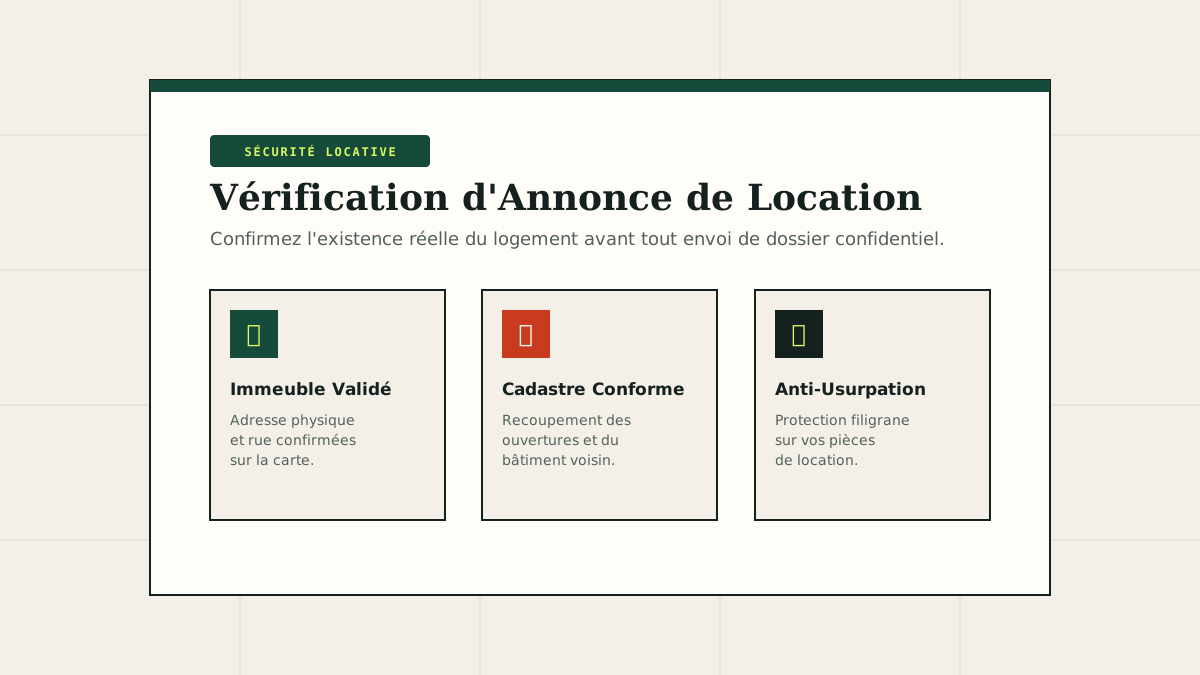
Never transmit raw identity or tax documents prior to a confirmed physical property viewing. Secure your tenant application using the official French government platform DossierFacile (.gouv.fr), which applies indelible protective watermarks to prevent identity theft and document forgery.
The French government service DossierFacile states that its agents check an applicant's file and help correct it where needed. It then provides a secured application through a URL or PDF and places watermarks on the documents to protect against fraud. Use only the official domain ending in `.gouv.fr`, as DossierFacile also warns that fraudulent websites imitate the service.
A checked and watermarked application helps protect the applicant's files, but it does not certify the recipient. Limit unnecessary data, use controlled link access when appropriate, and remove access when an application is abandoned. Do not let competition for a home turn a premature request into an apparently routine step.
What evidence should you preserve before reporting the listing?
Preserve the material before blocking the account or before the platform removes the advert. Keep the collection factual. Do not continue engaging with the advertiser or conduct your own investigation merely to obtain more evidence.
- capture the complete page with its URL, reference, date, rent, description, and public advertiser profile;
- retain the available original photos and the earlier pages found through reverse image search;
- export emails and messages with dates, account identifiers, and displayed contact information;
- save payment instructions, bank details, receipts, transfer confirmations, and the amount requested;
- write a short timeline separating what the listing claimed, what the contact requested, and what you actually sent or paid;
- store the files securely and do not publish them, because the record may include personal information.
Do not edit a screenshot to make it more persuasive. If an annotation helps your own filing, retain the untouched original as well. A dated evidence package can help the platform, bank, or competent services understand what happened. It still does not make a matching address proof that the advertiser had authority.
What should you do when you suspect a rental scam in France?
Stop sending money or documents, then report the listing to the portal with its URL and the evidence already preserved. If you sent money or exposed banking information, the Service Public page advises contacting the bank quickly to discuss opposition, payment disputes, or the measures relevant to the payment method.
For an online fake-listing report through THESEE, Service Public specifies two cumulative eligibility conditions: you must not have physically met the fraudulent advertiser, meaning the relationship remained entirely online, and money must have been requested. The money does not need to have been transferred or received. According to the official page, this reporting route is open to adult and minor victims or witnesses.
A THESEE report is not a criminal complaint. It informs investigators of the suspected offence and supplies material that may help identify the person responsible. Service Public says a reporter will not be kept informed of the outcome. The same official page separately explains complaint options, including an online THESEE complaint when its conditions are met, and notes different rules such as minors being unable to file that online complaint.
If the online service's conditions do not fit the situation, consult the official Service Public portal for alternative filing procedures. Follow standard due diligence and evidence preservation workflows before taking legal action.
Frequently asked questions
Does an exact address prove that the landlord is genuine?
No. A scammer can copy the address and photos of a genuine apartment. The building's existence proves neither ownership, authority, availability, nor the legitimacy of a payment request.
Does finding a photo elsewhere automatically prove fraud?
No. Unexplained reuse is important, especially when the source describes another city or property. Compare dates, other images, the viewing process, and the advertiser's independently verified authority before drawing a conclusion.
Should I send identity documents before a viewing?
Service Public identifies requests for official documents before viewing as a fake-listing warning sign. Question the purpose and timing, limit what you send, and use protected documents rather than assuming a real address makes the recipient safe.
Does DossierFacile confirm that the landlord is trustworthy?
No. DossierFacile checks and protects the applicant's file as part of its service. It does not turn a real address into proof of the recipient's identity or authority.
Can I report through THESEE if I did not pay?
Yes for the report described by Service Public if both conditions are met: the relationship remained entirely virtual and a sum of money was requested. Payment or receipt is not required. The report is not a complaint.
Can FindAddressNow certify a rental listing?
No. A search may identify an address candidate and test the geographic consistency of a compatible listing. It cannot certify the landlord, authority to let, proposed lease, property availability, or listing legitimacy.
How should you secure a rental application step by step?
To eliminate rental scam risks and prevent identity theft, follow this safety protocol:
- Verify building existence and cadastral parcel: Match the facade and plot layout on cadastre.gouv.fr to confirm the building is real.
- Watermark all application documents: Process your application files through DossierFacile (.gouv.fr) to apply official watermarks before sharing.
- Refuse money transfers before lease execution: Never pay reservation fees, deposits, or holding money before inspecting the property and signing a lawful tenancy contract.
- Preserve evidence for official reporting: Save listing URLs, email headers, and payment requests to submit reports via the official THESEE portal if fraud is suspected.
Already have a listing?
Find an address